CUORE Cryogenic Underground Observatory for Rare Events
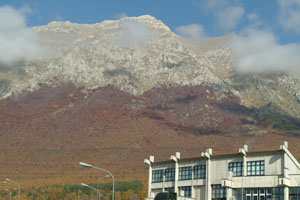 | 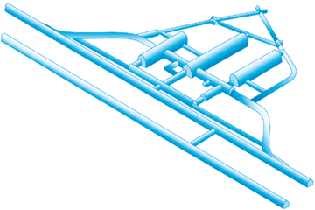 | 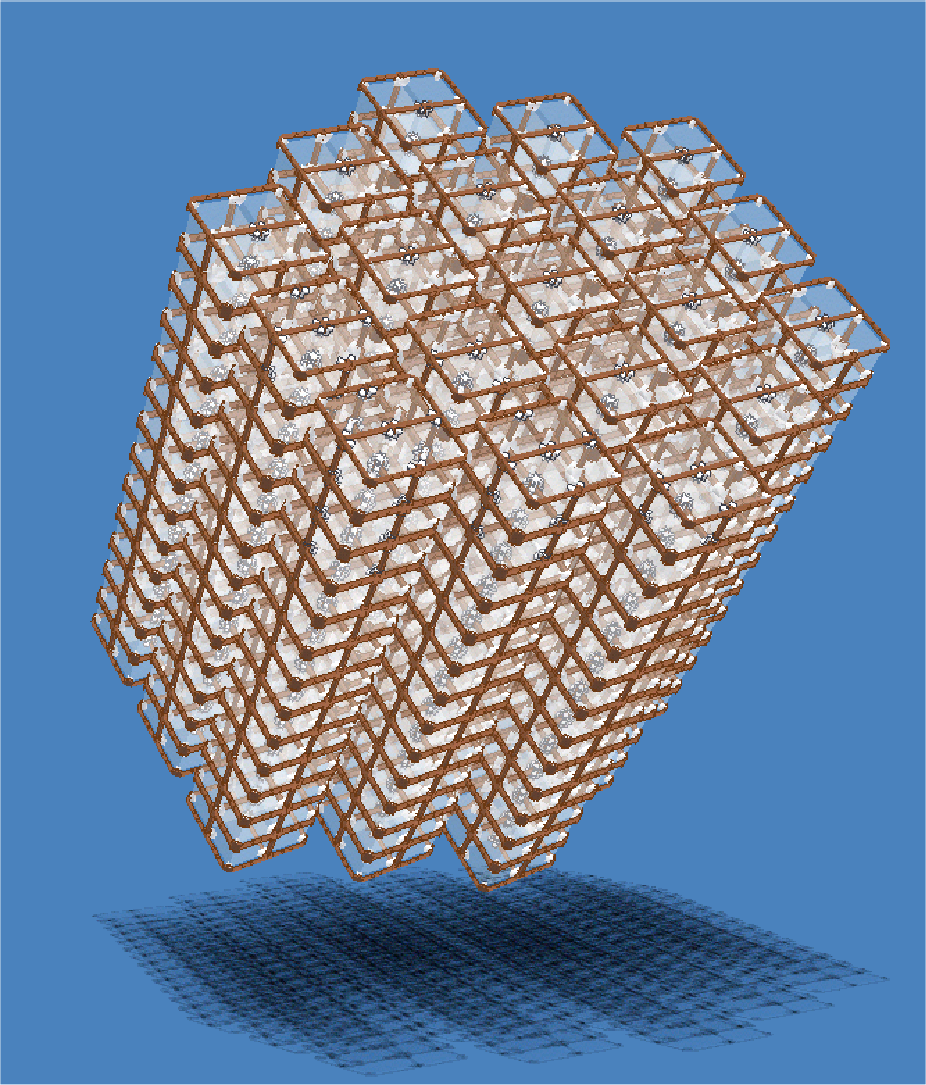 |
| CUORE location: the Gran Sasso mountain. | The underground (3400 m.w.e.) laboratory. | CUORE detector |
Although the existence of neutrino oscillations seems now to be well proved, several neutrino properties are still unknown. We know, for example, that neutrinos are massive but we ignore what the absolute scale of these masses is. The measurement of neutrino masses and mixing angles (and phases), as well as the assessment of the Dirac/Majorana character of neutrinos, will be the goal of the next generation experiments.  In this scenario a unique role is played by Neutrinoless Double Beta Decay searches (which represent the only experiments able to prove the Majorana character of neutrinos while obtaining informations on the neutrino mass hierarchy and Majorana phases). Low Temperature Detectors (LTD) have already proved to be powerful - and highly competitive devices - in this field. Proposed for Rare Events Searches in 1984 by E.Fiorini and T.Niinikovsky, they were pioneered in the course of the last 20 years by the Milano Weak Interaction Group which developed large mass TeO2 arrays to study Neutrinoless Double Beta decay of 130Te, an experience that culminated in the MiDBD experiment.
In this scenario a unique role is played by Neutrinoless Double Beta Decay searches (which represent the only experiments able to prove the Majorana character of neutrinos while obtaining informations on the neutrino mass hierarchy and Majorana phases). Low Temperature Detectors (LTD) have already proved to be powerful - and highly competitive devices - in this field. Proposed for Rare Events Searches in 1984 by E.Fiorini and T.Niinikovsky, they were pioneered in the course of the last 20 years by the Milano Weak Interaction Group which developed large mass TeO2 arrays to study Neutrinoless Double Beta decay of 130Te, an experience that culminated in the MiDBD experiment.The CUORE project was given to light in 1998 and now the CUORE Collaboration involves several European and American Institutions and about 120 researchers working together to built the largest cryogenic array ever realized: a ~ ton detector that will be capable to investigate the Majorana mass to the 50 meV scale.
The test bench for CUORE has been the CUORICINO experiment working from 2003 to 2008 in Laboratori Nazionali del Gran Sasso (L'Aquila, Italy). New technologies developed for CUOREhave been successfully tested in CUORE0, an array of 52 TeO2 bolometers completely identical to one of the 19 towers of CUORE and operated since 2013 in the same cryogenic structure which hosted Cuoricino. Indeed CUORE0 has been built using the same materials and recipes developed for CUORE and its results concenrning the performance and background level of the new designed CUORE detectors is the best demonstration that the design goasl of CUORE have been met.
last updated on: 08.04.2015, 21:39 by Ollie